 Tom Hundley
Architecting intelligent systems for performance, reliability, and global deployment
The convergence of artificial intelligence and cloud-native technologies has created unprecedented opportunities for organizations to build, deploy, and scale intelligent applications. But with this opportunity comes complexity—how do you architect AI systems that can handle millions of users, process terabytes of data, and deliver insights in real-time while maintaining cost efficiency and reliability?
This comprehensive guide explores the principles, patterns, and practices for building cloud-native AI solutions that scale from startup MVP to enterprise-grade systems serving global markets.
The future belongs to organizations that can harness AI at cloud scale—those that build intelligence into every interaction, every process, and every decision. - Sundar Pichai, CEO Google
1. Microservices-Based AI Components 🧩
2. Container-First Development 📦
3. API-Driven Integration 🔌
4. Event-Driven Processing ⚡
Kubernetes Orchestration:
# AI Model Deployment Configuration
apiVersion: apps/v1
kind: Deployment
metadata:
  name: recommendation-engine
  labels:
    app: ai-recommendation
    version: v2.1
spec:
  replicas: 5
  selector:
    matchLabels:
      app: ai-recommendation
  template:
    metadata:
      labels:
        app: ai-recommendation
    spec:
      containers:
      - name: recommendation-service
        image: ai-registry/recommendation:v2.1
        resources:
          requests:
            memory: 2Gi
            cpu: 1000m
            nvidia.com/gpu: 1
          limits:
            memory: 8Gi
            cpu: 4000m
            nvidia.com/gpu: 1
        env:
        - name: MODEL_PATH
          value: /models/recommendation_v2.1
        - name: REDIS_URL
          valueFrom:
            secretKeyRef:
              name: redis-secret
              key: url
Service Mesh Integration:
Model Serving Platforms:
| Platform | Best For | Key Features | Scale Capacity |
|---|---|---|---|
| KServe | Kubernetes-native | Auto-scaling, multi-framework | 10K+ req/sec |
| Seldon Core | Complex pipelines | Advanced routing, explainability | 50K+ req/sec |
| TorchServe | PyTorch models | Native PyTorch integration | 100K+ req/sec |
| TensorFlow Serving | TensorFlow models | High-performance serving | 200K+ req/sec |
| NVIDIA Triton | Multi-GPU inference | Optimized for GPU workloads | 500K+ req/sec |
Service Decomposition Strategy:
🎯 AI Service Boundaries
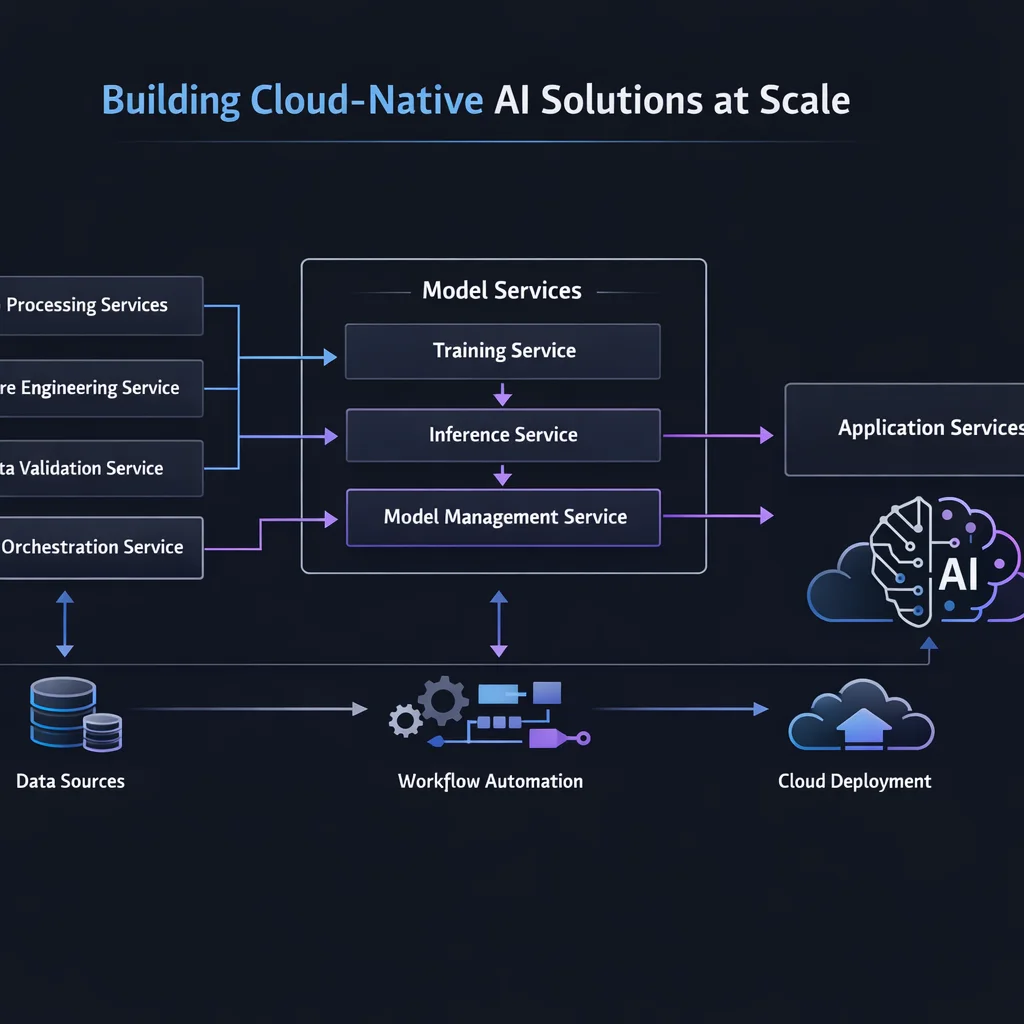Benefits of Microservices AI:
Event Streaming Architecture:
# Apache Kafka Integration for Real-time AI
from kafka import KafkaProducer, KafkaConsumer
import json
import asyncio

class AIEventProcessor:
    def __init__(self):
        self.producer = KafkaProducer(
            bootstrap_servers=[kafka-cluster:9092],
            value_serializer=lambda v: json.dumps(v).encode(utf-8)
        )

    async def process_user_event(self, user_event):
        # Extract features for real-time inference
        features = self.extract_features(user_event)

        # Trigger AI processing
        prediction = await self.model_inference(features)

        # Publish result to downstream services
        result_event = {
            user_id: user_event[user_id],
            prediction: prediction,
            timestamp: user_event[timestamp],
            model_version: v2.1
        }

        self.producer.send(ai-predictions, result_event)

    async def model_inference(self, features):
        # Call AI model service
        async with aiohttp.ClientSession() as session:
            async with session.post(
                http://model-service/predict,
                json={features: features}
            ) as response:
return await response.json()Tenant Isolation Strategies:
Quantization and Pruning:
import torch
import torch.quantization as quantization

class OptimizedAIModel:
    def __init__(self, model_path):
        self.model = torch.load(model_path)

    def quantize_model(self):
        Reduce model size and improve inference speed
        self.model.eval()

        # Post-training quantization
        quantized_model = quantization.quantize_dynamic(
            self.model,
            {torch.nn.Linear},
            dtype=torch.qint8
        )

        return quantized_model

    def optimize_for_inference(self):
        Apply TorchScript optimization
        traced_model = torch.jit.trace(
            self.model,
            torch.randn(1, 784)  # Example input shape
        )

        # Further optimization
        optimized_model = torch.jit.optimize_for_inference(traced_model)
        return optimized_model
Caching Strategies:
# Redis Configuration for Model Caching
apiVersion: v1
kind: ConfigMap
metadata:
  name: ai-cache-config
data:
  redis.conf: |
    maxmemory 8gb
    maxmemory-policy allkeys-lru
    save 900 1
    save 300 10
save 60 10000Horizontal Pod Autoscaler for AI Workloads:
apiVersion: autoscaling/v2
kind: HorizontalPodAutoscaler
metadata:
  name: ai-model-hpa
spec:
  scaleTargetRef:
    apiVersion: apps/v1
    kind: Deployment
    name: ai-inference-service
  minReplicas: 3
  maxReplicas: 50
  metrics:
  - type: Resource
    resource:
      name: cpu
      target:
        type: Utilization
        averageUtilization: 70
  - type: Resource
    resource:
      name: memory
      target:
        type: Utilization
        averageUtilization: 80
  - type: Pods
    pods:
      metric:
        name: inference_requests_per_second
      target:
        type: AverageValue
averageValue: 100Centralized Feature Management:
from feast import FeatureStore
import pandas as pd

class CloudNativeFeatureStore:
    def __init__(self):
        self.store = FeatureStore(repo_path=.)

    def register_features(self):
        Register feature definitions
        feature_definition =
        from feast import Entity, Feature, FeatureView, ValueType
        from feast.data_source import BigQuerySource

        user_entity = Entity(
            name=user_id,
            value_type=ValueType.INT64,
            description=User identifier
        )

        user_features = FeatureView(
            name=user_activity_features,
            entities=[user_id],
            ttl=timedelta(days=1),
            features=[
                Feature(page_views_7d, ValueType.INT64),
                Feature(purchases_30d, ValueType.INT64),
                Feature(avg_session_duration, ValueType.DOUBLE),
            ],
            batch_source=BigQuerySource(
                table_ref=project.dataset.user_features
            )
        )


    async def get_online_features(self, entity_ids):
        Retrieve features for real-time inference
        feature_vector = await self.store.get_online_features(
            features=[
                user_activity_features:page_views_7d,
                user_activity_features:purchases_30d,
                user_activity_features:avg_session_duration
            ],
            entity_rows=[{user_id: uid} for uid in entity_ids]
        )

return feature_vector.to_dict()Model Protection Strategies:
# Network Policies for AI Services
apiVersion: networking.k8s.io/v1
kind: NetworkPolicy
metadata:
  name: ai-model-security
spec:
  podSelector:
    matchLabels:
      tier: ai-inference
  policyTypes:
  - Ingress
  - Egress
  ingress:
  - from:
    - namespaceSelector:
        matchLabels:
          name: api-gateway
    - podSelector:
        matchLabels:
          app: load-balancer
    ports:
    - protocol: TCP
      port: 8080
  egress:
  - to:
    - namespaceSelector:
        matchLabels:
          name: data-services
    ports:
    - protocol: TCP
      port: 5432  # Database
  - to:
    - namespaceSelector:
        matchLabels:
          name: feature-store
    ports:
    - protocol: TCP
port: 6379 # RedisPrometheus Metrics for AI Models:
from prometheus_client import Counter, Histogram, Gauge, start_http_server

class AIModelMetrics:
    def __init__(self):
        # Model performance metrics
        self.prediction_requests = Counter(
            ai_prediction_requests_total,
            Total prediction requests,
            [model_name, version]
        )

        self.prediction_latency = Histogram(
            ai_prediction_duration_seconds,
            Prediction latency,
            [model_name, version],
            buckets=[0.1, 0.5, 1.0, 2.0, 5.0]
        )

        self.model_accuracy = Gauge(
            ai_model_accuracy,
            Current model accuracy,
            [model_name, version]
        )

        self.prediction_errors = Counter(
            ai_prediction_errors_total,
            Prediction errors,
            [model_name, version, error_type]
        )

    def record_prediction(self, model_name, version, latency, accuracy=None):
        Record prediction metrics
        self.prediction_requests.labels(
            model_name=model_name,
            version=version
        ).inc()

        self.prediction_latency.labels(
            model_name=model_name,
            version=version
        ).observe(latency)

        if accuracy:
            self.model_accuracy.labels(
                model_name=model_name,
                version=version
).set(accuracy)Scale Requirements:
Architecture Solution:
🏗️ Architecture Components
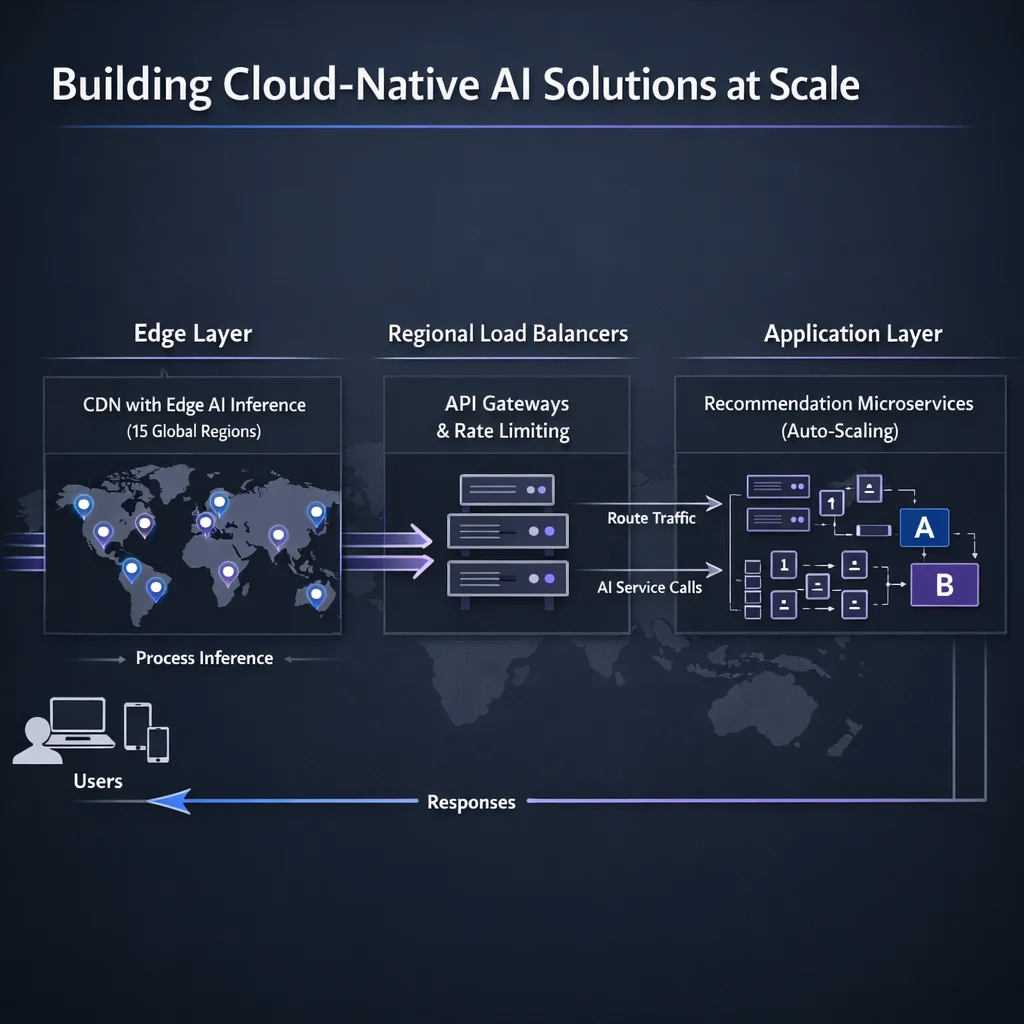Performance Results:
Requirements:
Security-First Architecture:
# Healthcare AI Security Configuration
apiVersion: v1
kind: Namespace
metadata:
  name: healthcare-ai
  labels:
    compliance: hipaa
    encryption: required
Compliance Results:
Edge AI Integration:
class EdgeAIManager:
    def __init__(self):
        self.edge_nodes = self.discover_edge_nodes()

    def deploy_lightweight_models(self):
        Deploy optimized models to edge locations
        for edge_node in self.edge_nodes:
            optimized_model = self.create_edge_optimized_model(
                base_model=self.production_model,
                constraints=edge_node.resource_limits
            )

            self.deploy_to_edge(optimized_model, edge_node)

    def implement_federated_learning(self):
        Enable privacy-preserving distributed learning
        federated_config = {
            aggregation_strategy: FedAvg,
            client_selection: random,
            rounds: 100,
            min_clients: 10,
            privacy_budget: 1.0  # Differential privacy
        }

return self.start_federated_training(federated_config)Cloud-native AI represents more than just a technological evolution—its a fundamental shift in how we build, deploy, and scale intelligent systems. Organizations that master cloud-native AI principles will be positioned to:
The key to success lies in embracing cloud-native principles while understanding the unique requirements of AI workloads. Start with solid foundations, implement robust monitoring and security, and continuously optimize for performance and cost.
This article is a live example of the AI-enabled content workflow we build for clients.
| Stage | Who | What |
|---|---|---|
| Research | Claude Opus 4.5 | Analyzed current industry data, studies, and expert sources |
| Curation | Tom Hundley | Directed focus, validated relevance, ensured strategic alignment |
| Drafting | Claude Opus 4.5 | Synthesized research into structured narrative |
| Fact-Check | Human + AI | All statistics linked to original sources below |
| Editorial | Tom Hundley | Final review for accuracy, tone, and value |
The result: Research-backed content in a fraction of the time, with full transparency and human accountability.
Were an AI enablement company. It would be strange if we didnt use AI to create content. But more importantly, we believe the future of professional content isnt AI vs. Human—its AI amplifying human expertise.
Every article we publish demonstrates the same workflow we help clients implement: AI handles the heavy lifting of research and drafting, humans provide direction, judgment, and accountability.
Want to build this capability for your team? Lets talk about AI enablement →
Discover more content:
