 Tom Hundley
The customer journey map hanging in your conference room is lying to you. It shows a linear path from awareness to purchase, with neat touchpoints and predictable behaviors. Real customer journeys look nothing like this—theyre chaotic, non-linear, and increasingly shaped by AI-powered experiences your competitors are already deploying.
The Global Customer Journey Orchestration Market is projected to reach $12.5 billion in 2025, growing at a CAGR of 24.0% through 2034. In the US alone, this market is valued at $3.9 billion in 2025 and expected to reach $24.0 billion by 2034.
The organizations investing in this space understand something critical: static journey maps are being replaced by dynamic orchestration systems that adapt in real-time. The question isnt whether to adopt AI-powered journey orchestration—its how quickly you can do it without breaking what works.
Heres the uncomfortable reality: according to Deloittes State of Personalization report, consumers rate only 43% of their experiences as personalized, while brands believe they deliver 61%. That 18-point gap represents both a problem and an opportunity.
The gap exists because most personalization is still rule-based. If customer segment = X, show message Y doesnt feel personal—it feels like being sorted into a bucket. True personalization requires understanding context, predicting intent, and adapting in real-time.
This is where AI journey orchestration changes the game.
Traditional marketing automation follows predetermined paths:
AI orchestration operates differently:
The shift is from if-then rules to predict-optimize-learn loops.
The numbers make the strategic case clear:
| Metric | Impact |
|---|---|
| Revenue lift from hyper-personalization | Up to 40% more revenue for retailers vs. non-personalized |
| Customer purchase likelihood | 80% more likely to purchase from companies offering personalized experiences |
| Customer expectations | 71% expect personalized interactions according to McKinsey |
| Omnichannel retention | 91% higher YoY retention for companies with omnichannel strategies |
Real-world implementations demonstrate this potential:
Despite the compelling ROI, adoption remains challenging. According to the Adobe 2025 AI and Digital Trends report, 75% of practitioners consider real-time personalization a major challenge, with fragmented content, data, and journeys preventing organizations from unifying around their customers.
The barriers are primarily organizational, not technical:
Customer data lives in silos—CRM here, web analytics there, support tickets somewhere else. AI orchestration requires unified customer profiles, and most organizations underestimate the data integration effort.
Real-time personalization requires content variations for different contexts. Most organizations dont have enough content to personalize meaningfully, even when the AI knows what would work best.
Journey orchestration crosses departmental boundaries. Marketing owns some touchpoints, sales owns others, support owns still others. No one owns the whole journey.
Existing martech stacks werent designed for real-time AI orchestration. Rip-and-replace is expensive; integration is complex.
Effective AI journey orchestration requires four interconnected layers:
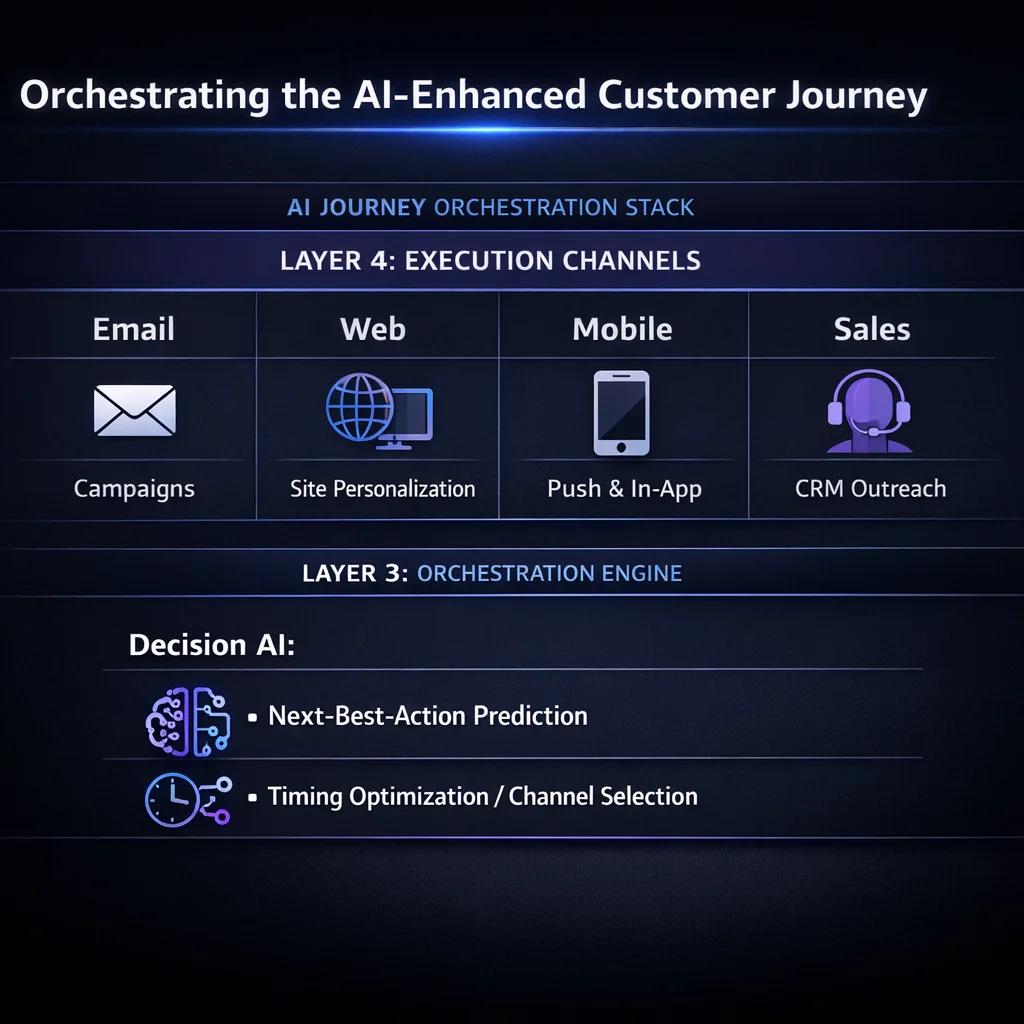
Without a single customer view, orchestration is impossible. This layer combines:
This is where AI adds value. Models continuously evaluate:
The decision engine that selects the optimal action:
The channels that deliver experiences:
Focus: Data unification and basic intelligence
Success metric: Single customer view covering 80%+ of interactions
Focus: Predictive capabilities and journey mapping
Success metric: Prediction accuracy above 70% for key behaviors
Focus: Decision engine and channel coordination
Success metric: Orchestrated journeys covering top 3 customer segments
Focus: Continuous improvement and expansion
Success metric: Year-over-year improvement in engagement and conversion
Heres a warning: implementing AI orchestration wont automatically improve customer experience. Forresters 2025 CX Index reports that CX quality has declined for the fourth consecutive year, with only 7% of brands improving.
The organizations that succeed treat AI as an enabler of better experiences, not a replacement for customer understanding. The technology should amplify human insight, not substitute for it.
According to Gartner, 95% of all customer interactions will be powered by AI by 2025. Autonomous decision engines are expected to reduce manual intervention by 60% by 2027.
The organizations investing now in AI journey orchestration arent just improving efficiency—theyre building competitive moats. The ability to deliver relevant, contextual experiences at every touchpoint compounds over time. The more data you collect, the better your models become, the more effective your orchestration, the more data you collect.
Your static journey maps served their purpose. Its time to replace them with dynamic systems that learn, adapt, and improve with every customer interaction.
div class=ai-collaboration-card
This article is a live example of the AI-enabled content workflow we build for clients.
| Stage | Who | What |
|---|---|---|
| Research | Claude Opus 4.5 | Analyzed current industry data, studies, and expert sources |
| Curation | Tom Hundley | Directed focus, validated relevance, ensured strategic alignment |
| Drafting | Claude Opus 4.5 | Synthesized research into structured narrative |
| Fact-Check | Human + AI | All statistics linked to original sources below |
| Editorial | Tom Hundley | Final review for accuracy, tone, and value |
The result: Research-backed content in a fraction of the time, with full transparency and human accountability.
/div
Were an AI enablement company. It would be strange if we didnt use AI to create content. But more importantly, we believe the future of professional content isnt AI vs. Human—its AI amplifying human expertise.
Every article we publish demonstrates the same workflow we help clients implement: AI handles the heavy lifting of research and drafting, humans provide direction, judgment, and accountability.
Want to build this capability for your team? Lets talk about AI enablement →
Discover more content:
