 Tom Hundley
The math has become brutal. SaaS companies today are spending $2 for every $1 of new annual recurring revenue they acquire. With average customer acquisition costs hitting around $700 and climbing 14% year-over-year, the traditional growth playbook is breaking down.
Companies in the highest spending quartile are hemorrhaging nearly $2.82 for every dollar of ARR they bring in. This isn't a minor inefficiency—it's a crisis that's silently draining millions from marketing budgets and making profitable growth increasingly elusive.
The solution isn't to spend less. It's to spend smarter. And AI is emerging as the primary lever for CROs who need to acquire customers profitably.
The pressure is coming from multiple directions:
| Channel | Average CAC | Trend |
|---|---|---|
| Social Media Advertising | $1,100 | Increasing (Meta, TikTok, LinkedIn costs up) |
| Content Marketing | $700-900 | Stable but competitive |
| eCommerce | $274 | Increasing due to personalization expectations |
| B2B SaaS | $500-700 | Highly variable by segment |
Marketing leaders across industries are grappling with a perfect storm: digital advertising costs continue to rise while conversion rates plateau, creating a squeeze that forces teams to do more with less.
Privacy changes have made targeting less precise. Third-party cookies are disappearing. Competition for attention intensifies daily. The channels that worked five years ago deliver diminishing returns.
Against this backdrop, AI-powered optimization has emerged as a structural advantage. By 2025, AI-driven methodologies have significantly reshaped CAC benchmarks, with companies leveraging AI successfully reducing their CAC by 30-37% compared to traditional acquisition strategies.
The mechanisms are straightforward:
AI concentrates spend through precision targeting and lookalike audiences. Instead of casting wide nets, AI identifies the specific segments most likely to convert and focuses resources there.
Traditional campaigns optimize weekly or monthly. AI-powered campaigns shift bids and budgets to top segments in real-time, capturing opportunities as they emerge and cutting losses as they develop.
AI enables dynamic creative optimization—the right message to the right person at the right time. This lifts conversion rates without proportional cost increases.
Not all leads are created equal. With AI lead scoring, leads get a predictive score based on the likelihood they will convert within a specific timeframe. This allows sales to focus on high-probability opportunities, dramatically improving conversion efficiency.
The impact is measurable:
| Metric | AI Impact |
|---|---|
| CAC Reduction | 30-37% average |
| Conversion Rate Improvement | 20-30% with AI chatbots and personalization |
| Engagement Lift | Up to 74% with AI segmentation |
| Lead Quality Improvement | 40%+ with intent-based targeting |
The shift from traditional cookie-based targeting to intent-based, first-party data strategies allows B2B teams to cut CAC by 30-50%. This isn't marginal optimization—it's a fundamental improvement in acquisition economics.
Effective AI-driven CAC optimization requires capabilities across the acquisition funnel:
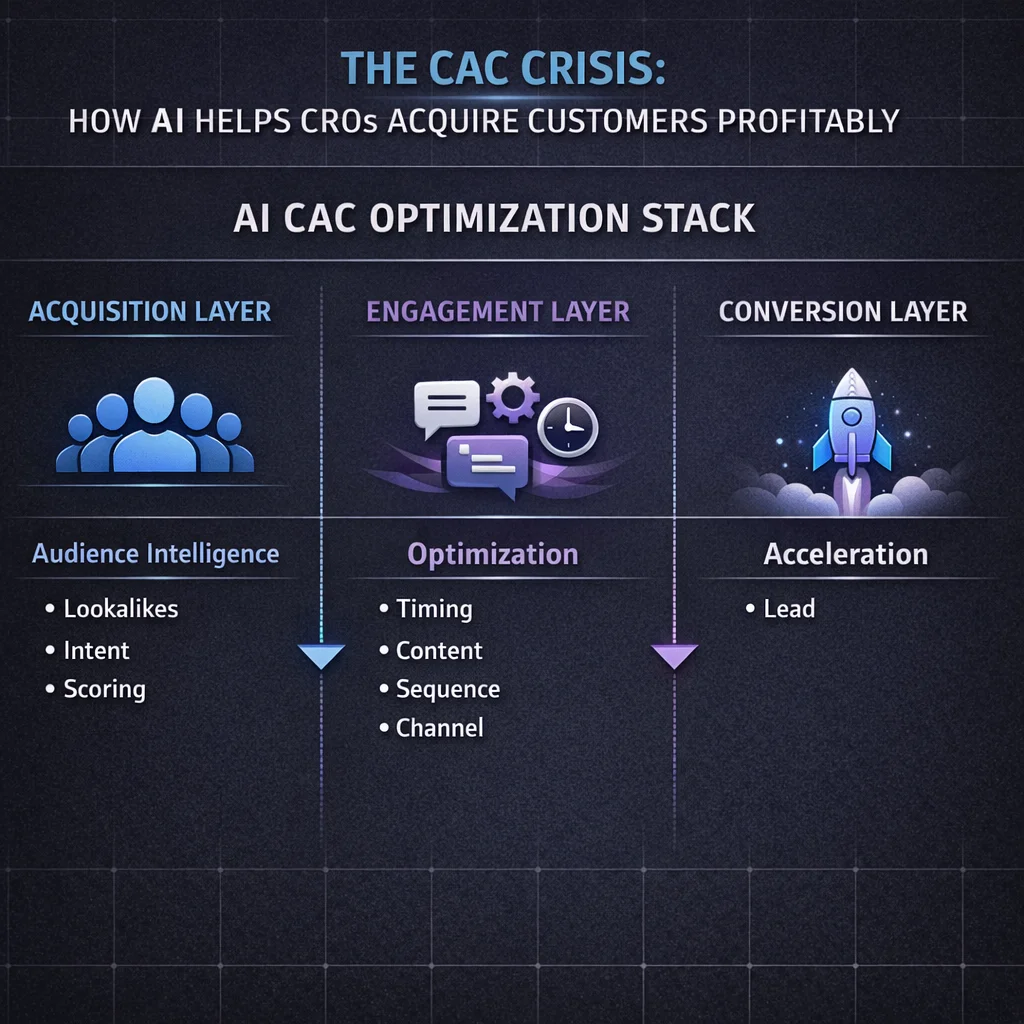
AI is also enabling new acquisition approaches:
Creator partnerships deliver 30-40% lower costs per lead than traditional advertising. AI helps identify creators whose audiences match your ICP and predict partnership ROI.
AI-powered chatbots improve conversion rates 20-30% through instant engagement, qualification, and routing. They capture intent at the moment its expressed.
As AI search (ChatGPT, Perplexity, Google AI Overviews) captures market share, optimization for AI-generated results becomes a new acquisition channel with potentially lower CAC than traditional SEO.
Companies using integrated marketing platforms show 35% better results than fragmented tool approaches. AI works best when it can see and optimize across the full customer journey.
Focus: Understanding current state
Success metric: Complete CAC visibility by channel and segment
Focus: AI-enabled optimization of existing campaigns
Success metric: 10-15% CAC reduction in optimized channels
Focus: Smarter targeting
Success metric: 20%+ improvement in conversion rates
Focus: End-to-end optimization
Success metric: 30%+ sustained CAC reduction
CAC optimization can't happen in isolation. The ratio that matters is LTV:CAC—lifetime value relative to acquisition cost.
Healthy benchmarks:
AI helps on both sides of this equation:
The compounding effect: when AI identifies customers likely to have high LTV, and optimizes acquisition to reach them efficiently, both sides of the ratio improve simultaneously.
AI can easily optimize for lead volume, driving up vanity metrics while CAC stays elevated. Always optimize for downstream conversion or revenue, not top-of-funnel metrics.
Multi-touch journeys make attribution hard. AI that optimizes based on flawed attribution will make flawed decisions. Invest in attribution modeling before AI optimization.
Some AI optimizations that reduce immediate CAC harm long-term brand or market positioning. Maintain human oversight on strategic direction.
AI amplifies data quality issues. Bad data leads to confident but wrong optimization. Clean your data before deploying AI.
The CAC crisis is real, but it's not insurmountable. AI-enhanced personalization reduces CAC by up to 50% for organizations that implement it thoughtfully.
The organizations that master AI-powered acquisition will grow profitably while competitors struggle with unsustainable economics. The gap will widen over time as AI systems learn and improve.
For CROs, the question isn't whether to invest in AI-powered CAC optimization. It's how quickly you can implement it—and how thoroughly you can embed it into your acquisition engine.
The companies spending $2.82 to acquire $1 of ARR won't survive indefinitely. The companies that use AI to acquire customers at a fraction of that cost will inherit their market share.
div class=ai-collaboration-card
This article is a live example of the AI-enabled content workflow we build for clients.
| Stage | Who | What |
|---|---|---|
| Research | Claude Opus 4.5 | Analyzed current industry data, studies, and expert sources |
| Curation | Tom Hundley | Directed focus, validated relevance, ensured strategic alignment |
| Drafting | Claude Opus 4.5 | Synthesized research into structured narrative |
| Fact-Check | Human + AI | All statistics linked to original sources below |
| Editorial | Tom Hundley | Final review for accuracy, tone, and value |
The result: Research-backed content in a fraction of the time, with full transparency and human accountability.
/div
We're an AI enablement company. It would be strange if we didn't use AI to create content. But more importantly, we believe the future of professional content isn't AI vs. Human—its AI amplifying human expertise.
Every article we publish demonstrates the same workflow we help clients implement: AI handles the heavy lifting of research and drafting, humans provide direction, judgment, and accountability.
Want to build this capability for your team? Let's talk about AI enablement →
Discover more content:
