 Tom Hundley
The Six Sigma black belts and lean manufacturing experts who defined operational excellence for decades are facing an uncomfortable truth: AI is rewriting the playbook they mastered.
The scale of change is staggering. According to McKinsey, generative AI could automate 25% of workplace tasks in the near future, and when combined with other enabling technologies such as workflow automation, it could potentially automate tasks that currently absorb 60-70% of employees time.
This isn't just efficiency improvement—it's a fundamental restructuring of how operational excellence is defined, measured, and achieved. For COOs, the challenge is evolving from process optimization experts to AI-augmented operations architects.
66% of organizations now consider AI central or supplementary to their overall strategy, and 62% are already leveraging AI for operational efficiency. The laggards aren't just missing efficiency gains—they're falling behind on a capability that compounds over time.
The transformation is profound:
| Traditional Operations | AI-Era Operations |
|---|---|
| Reactive problem-solving | Predictive intervention |
| Historical analysis | Real-time intelligence |
| Rule-based automation | Adaptive automation |
| Periodic optimization | Continuous optimization |
| Human decision-making | Human-AI decision-making |
| Process standardization | Process personalization |
With predictive analytics, machine learning, and natural language processing, businesses can see ahead of time, prevent failures, and respond to complexities with greater accuracy. Decision-making once rooted in historical precedent and managerial judgment now involves real-time intelligence—making operations transition from reactive to proactive to predictive.
The role of Chief Operating Officer has transformed dramatically with the rise of artificial intelligence and automation technologies. Modern COOs must balance traditional operational excellence with digital transformation initiatives that leverage AI capabilities across the organization.
Digital COOs should be well-versed in:
This doesn't mean COOs need to become technologists. It means they need sufficient fluency to evaluate AI opportunities, ask the right questions, and make informed build-vs-buy decisions.
The COOs role is evolving from: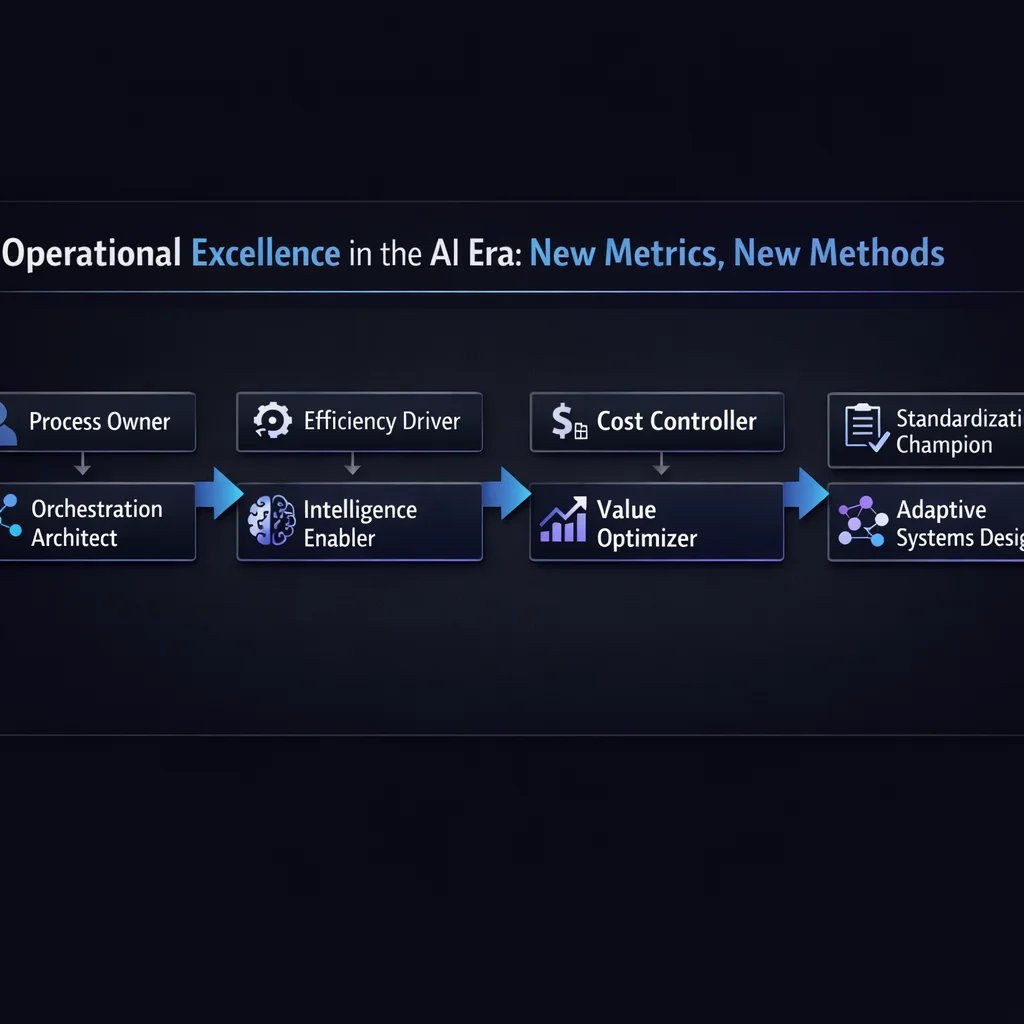
| Metric | Why It Matters |
|---|---|
| Cost per unit | Baseline efficiency measure |
| Cycle time | Speed of value delivery |
| Quality rate | Output consistency |
| Capacity utilization | Resource efficiency |
| Metric | What It Measures |
|---|---|
| Automation coverage | % of tasks handled by AI/automation |
| Prediction accuracy | How well AI forecasts outcomes |
| Human-AI collaboration efficiency | Output quality of augmented work |
| Adaptation velocity | Speed of AI model improvement |
| Exception rate | How often human intervention is required |
| AI ROI | Return on AI investments |
By 2025, 50% of CIOs will have performance metrics tied to the sustainability of the IT organization. COOs should expect similar evolution in operational metrics.
In the era of striving for operational excellence, companies reach for hyperautomation—combining many technologies (AI, machine learning, RPA) to automate everything possible.
Hyperautomation moves beyond automating individual tasks to automating entire workflows:
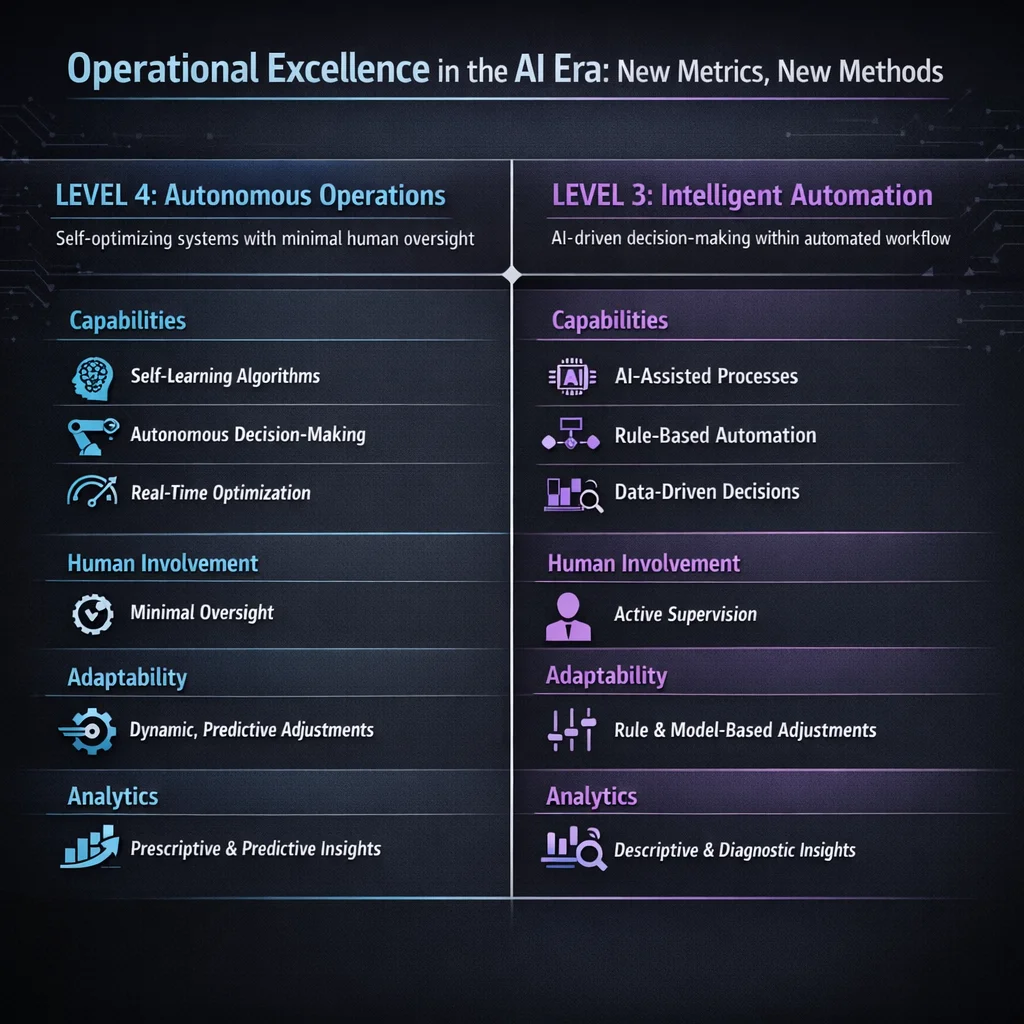
Automation complements intelligence by avoiding bottlenecks in delivery. Repetitive, rules-based work is streamlined by robotic process automation (RPA), while intelligent automation infuses AI for tackling dynamic, judgmental scenarios.
Rules-Based Automation (RPA)
Intelligent Automation (AI)
The strategic choice: which tasks belong in which category, and how do they hand off to each other?
The business case is compelling:
Focus: Understanding current state with AI-powered analysis
Success metrics:
Focus: Automating clear-cut tasks
Success metrics:
Focus: Adding AI to automation
Success metrics:
Focus: Self-improving operations
Success metrics:
The 60-70% task automation potential raises obvious workforce questions. The COOs challenge: managing this transition responsibly while capturing efficiency gains.
Rather than workforce reduction, leading organizations focus on workforce redeployment:
| From | To |
|---|---|
| Data entry | Data analysis |
| Report generation | Insight interpretation |
| Process execution | Exception handling |
| Routine decisions | Complex judgment calls |
| Task completion | Outcome ownership |
The strategy for 2025+ should include a plan for building infrastructure and competencies for scaling AI, selecting appropriate platforms, establishing success metrics for AI projects, and a process for evaluating them before expansion.
Operational excellence in the AI era isn't about replacing humans with machines. It's about creating systems where humans and AI each do what they do best: AI handles volume, speed, and pattern recognition; humans handle judgment, creativity, and relationship management.
The COOs who master this balance won't just run more efficient operations—they'll run operations that continuously improve, adapt to changing conditions, and create competitive advantages that compound over time.
div class=ai-collaboration-card
This article is a live example of the AI-enabled content workflow we build for clients.
| Stage | Who | What |
|---|---|---|
| Research | Claude Opus 4.5 | Analyzed current industry data, studies, and expert sources |
| Curation | Tom Hundley | Directed focus, validated relevance, ensured strategic alignment |
| Drafting | Claude Opus 4.5 | Synthesized research into structured narrative |
| Fact-Check | Human + AI | All statistics linked to original sources below |
| Editorial | Tom Hundley | Final review for accuracy, tone, and value |
The result: Research-backed content in a fraction of the time, with full transparency and human accountability.
/div
We're an AI enablement company. It would be strange if we didn't use AI to create content. But more importantly, we believe the future of professional content isn't AI vs. Human—its AI amplifying human expertise.
Every article we publish demonstrates the same workflow we help clients implement: AI handles the heavy lifting of research and drafting, humans provide direction, judgment, and accountability.
Want to build this capability for your team? Let's talk about AI enablement →
Discover more content:
